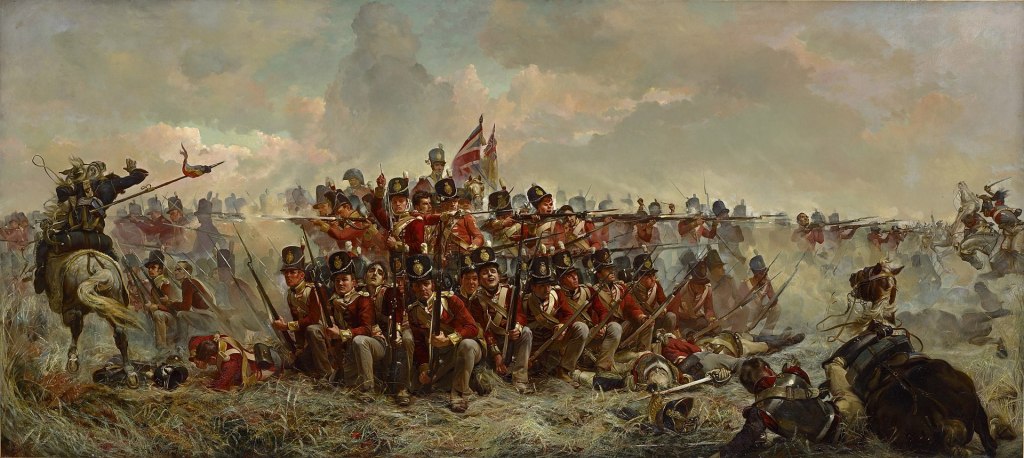
Whenever I find myself at the National Gallery here in Melbourne, sooner or later I find my way to a remarkable room hung in the 19th century ‘salon’ style which contains a vast array of pictures from that century. One of my favourites is this one, an enormous and vivid canvas that captures all the chaos, fear and the fierce exhilaration of battle.
It was painted in 1875 by a female artist, Elizabeth Thompson. She specialised in painting historical scenes, particularly scenes from various battles, and this is a fine example of her work. But what was the battle that she is depicting?
In fact, the Battle of Quatre Bras was one of two important engagements that preceded the much more famous Battle of Waterloo, which finally ended the Napoleonic Wars after Bonaparte’s so-called ‘Hundred Days’ campaign following his return from exile on the island of Elba.
The former Emperor had been in exile on Elba for ten months, from April 1814 until February 1815. At the end of February, in a typically bold move, his tiny flotilla slipped out of Portoferraio harbour, evaded the patrolling British and French ships, and a few days later landed with less than a thousand men at Golfe Juan, near Antibes on the south coast of France.
Cleverly avoiding the various Royalist garrisons that might have stopped him by taking a circuitous route through the Alps, he steadily picked up adherents along the way. Famously, when confronted with a contingent of troops opposing him at the village of Laffrey, he stepped out in front of them, ripped open his coat and said: ‘If any of you will shoot his Emperor, here I am.’ Needless to say, they threw down their arms and joined him. Further confrontations similarly melted away; even Marshal Michel Ney, formerly one of Napoleon’s generals and now commanding an army under King Louis XVIII, could not resist his former emperor’s charm, and joined him with 6,000 troops. By the 20th of March, Napoleon was in the capital and the Bourbon king had once again fled into exile.
Napoleon had frequently expressed a hope that his former enemies would leave him in peace. But the prospect of their ogre once again in a position to threaten the fragile European peace negotiated at the Congress of Vienna was too much, and they almost immediately proclaimed him an outlaw and declared war against him. The scene was set for the campaign that would lead to Waterloo.
Facing invasion from the same combination of British, Prussian, Austrian and Russian armies that had defeated him less than a year before, Napoleon had to decide whether to fight a defensive war or to take the offense. Unsurprisingly, he chose the latter, betting everything on a single throw of the dice. If he moved quickly he could engage the various armies one by one, before they could combine against him. A single crushing victory against any of them would, he gambled, bring the other powers to the negotiating table.
So, knowing that the Austrian and Russian armies were still some distance away and that the British and Prussian forces had not yet combined in Belgium, he crossed the River Sambre at the town of Charleroi on June 15th. This placed him between the British and Prussian armies so that they could not join each other (the Duke of Wellington, the commander of the British army, when he was told the news was heard to remark, ‘By God, he has humbugged me!’).
The next day, June 16th, Napoleon hurled the right wing of his army against the Prussians led by the aged but still vigorous Marshal Blucher, who were concentrating around the town of Ligny. Blucher was roundly defeated and forced into retreat.
Meanwhile, Marshal Ney, in command of the left wing of the French armies, engaged Wellington’s British at the town of Quatre Bras, which, as its name suggests, stands at an important crossroads. But he was not quite as successful as his master. Though he made initial gains, the British army put up a spirited defence, and by the end of the day, the French had been forced to withdraw to their original positions. It was a bloody engagement – Ney lost 4,000 men and Wellington 4,800 – and though its results were inconclusive the battle had a decisive impact on subsequent events.
Learning that his allies had been defeated at Ligny, Wellington was forced to withdraw northwards. But by denying Ney control of the crossroads at Quatre-Bras, he had bought vital time to regroup and take up his defensive position at Waterloo, where, as everyone knows, he prevailed (with the help of the Prussians, pursued by Napoleon’s dogged but unimaginative subordinate Marshal Grouchy, who failed to press his defeated enemy hard enough to prevent them joining up with Wellington).
Which brings us back to the painting. The British soldiers depicted in the picture belong to the 28th (Gloucestershire) Regiment of Foot. Veterans of Wellington’s long Peninsula campaigns in Portugal and Spain, they were tough, highly disciplined troops. During the Battle of Quatre-Bras, they fought in several important engagements and earned themselves a commendation from Wellington himself in his dispatches after Waterloo.
In the picture, they are shown in the typical defensive square formation usually adopted to defend against cavalry charges. The painter’s viewpoint is at a corner of the square and shows the two ranks of soldiers, one firing while the other, their muskets reloaded, wait for their turn. Around them, Ney’s cuirassiers and lancers swirl and trample the field underfoot. It is a perspective that shows to great effect the unique strength of such a formation, as well as creating a brilliant focal point for the painting.
Thompson went to great lengths to research and prepare before putting brush to canvas, going so far as to arrange for 300 soldiers from the Royal Engineers to pose in a reconstruction of the square formation and fire their rifles so as to recreate the smoky scene. She arranged for a group of children to trample down a field of rye in Henley-on-Thames to get the look of the grass in the foreground, and she had replica uniforms made by a government manufacturer in Pimlico – though purists have noted that she got some of the details of those uniforms wrong.
As a result, the painting has an immediacy that throws the viewer right into the action; you can almost smell the acrid smoke and hear the crackle of gunfire and the terrified whinnying of the horses. Seen close up, it is still today a powerful and evocative work, even if the name of the battle it depicts is almost entirely forgotten these days.
 Anthony R Wildman