Behind the Picture
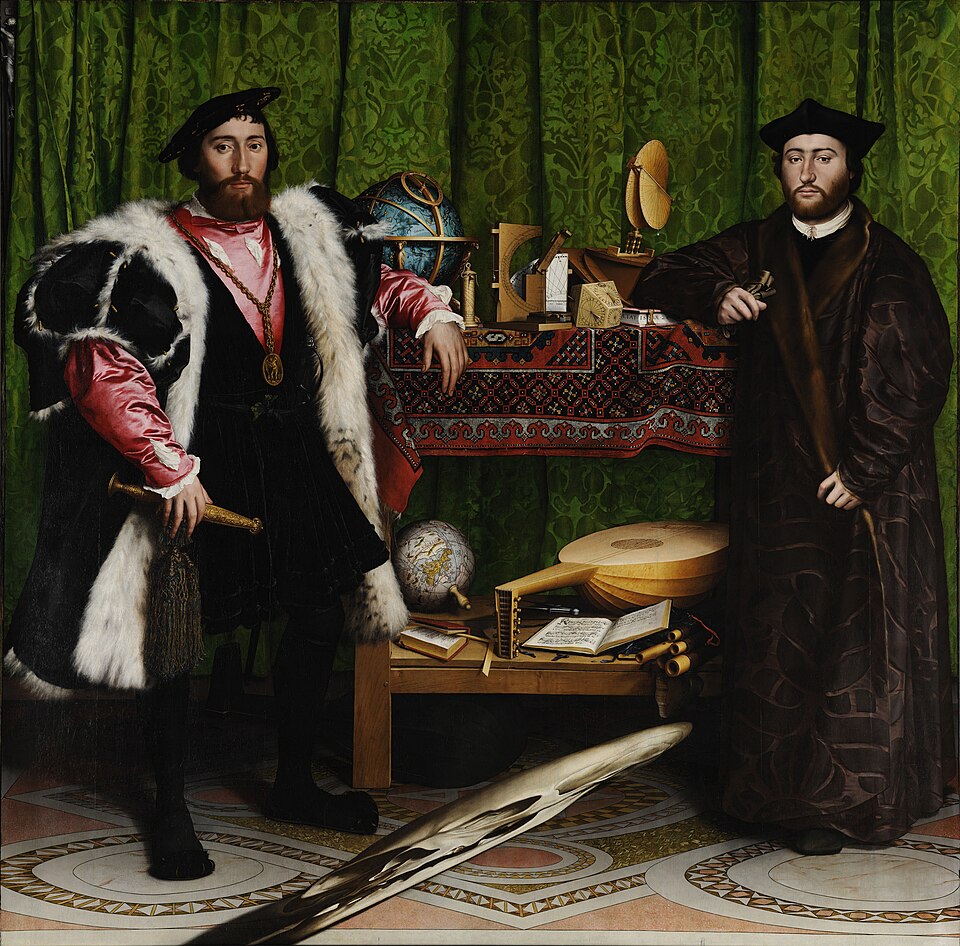
The year is 1533. For five years, the English King Henry VIII has been quarrelling with Pope Clement, who has refused to grant him a divorce from his wife, Katherine of Aragon. By the end of the year, Henry will have taken the fateful step of breaking from the Catholic church so that he can divorce Katherine and marry Anne Boleyn. Meanwhile, Parliament is hard at work erecting the legal scaffolding for what was to become known to history as the English Reformation, the final rejection of Catholicism in favour of a new English Protestant church. It is a turbulent and pivotal year in English history.
These drastic actions have implications far beyond England’s borders. The followers of Martin Luther are already undermining the religious and political order of Europe, challenging the religious authority of the papacy and the political hegemony over Germany of the Holy Roman Emperor, Charles V. By opening a path for European humanist philosophies and Lutheran teachings to expand their reach, Henry is creating a new headache for the king of France and the emperor, themselves locked into a decade-long struggle for supremacy over the Italian peninsula.
No one at the English court is more aware of the complex implications of the unfolding dynastic and political crisis than the man standing on the left of Hans Holbein’s famous painting made in that fateful year, The Ambassadors.
Jean de Dinteville is the 29-year-old French Ambassador to England, and he has the unenviable task of reporting on the goings-on at the Tudor court and influencing events as best he can in the interests of his master, King Francis I. Dinteville is dressed in the lavish fashion of a young man of the time, all silk, fur and velvet, and exudes an air of consequence, though there is the tiniest hint of a self-satisfied smirk on the face framed between collar and jauntily positioned hat.
But it is a thankless task. Although relations between France and England were, for once, reasonably amiable, the French king – a Catholic – was watching the unfolding dynastic and religious crisis across the Channel with concern. Luther’s teachings had taken hold in France, too, and were being resisted by the authorities; if the English king embraced Protestantism, it would be a powerful encouragement of the heretics in France. Dinteville, as Ambassador, is at the English court to try and influence events, something he finds almost impossible to do. Though the expression on his face in Holbein’s painting is pleasant enough, he had written home earlier that year that he was ‘the most melancholy, weary and wearisome ambassador in the world.’ Clearly, the pressures of keeping up with the court shenanigans have got the better of him.
No doubt he finds some consolation in the friendship of the man standing on the other side of the picture, his close friend Georges de Selve, clad more soberly in clerical garb – although his fur-lined and intricately patterned robe suggests that he, too, is a man of means. Just 25 years old, he has been Bishop of Lavaur for seven years, having been appointed at the tender age of 18. Already a seasoned diplomat, he has spent much of his young life engaged in the struggle to stem the tide of Lutheranism on the continent, and he is a source of tactical advice and a sympathetic ear for the beleaguered ambassador. He will serve his king in various ambassadorial postings before his early death in 1540.
Though the religious sympathies of the painter, Hans Holbein, are not known with any certainty, they are most likely anathema to the two subjects of his picture. Born in Augsburg, he is the son of a painter and draughtsman (Hans Holbein the Elder). Moving with his brother to the Swiss city of Basel, he has already established a career as a painter of religious images. Then, in 1523, he was commissioned to paint the great humanist scholar Erasmus, the first of the portraits that were to make him famous throughout Europe. In 1526, he travelled to London, carrying with him Erasmus’ letter recommending him to Sir Thomas More, then Chancellor of the Duchy of Lancaster, but soon to become Chancellor of England after the fall of Cardinal Wolsey. More was the subject of the first of several portraits produced in Holbein’s first stint in England. He went back to Basel for a time, but has been lured back to London by the prospect of rich commissions to paint the portraits of Lutheran merchants of the Hanseatic League.
It is his growing reputation as a portraitist that has attracted the attention of Anne Boleyn, King Henry’s new queen and mother of his daughter Elizabeth. She wishes to give a gift to Ambassador Dinteville and has commissioned Holbein to produce this double portrait of the ambassador and his friend. Once complete, the painting will travel back to France to hang in Dinteville’s chateau. Thereafter, it will have a peripatetic existence, eventually winding up at the National Gallery, where it hangs to this day.
The painting is remarkable in a number of ways. The two ambassadors are rendered in Holbein’s signature realistic style, typical of paintings of the Renaissance period. These are real flesh-and-blood people, painted almost life-size and subtly communicating their personalities through the expressions on their faces, the clothes they wear, the stance they take, and the objects they hold in their hands. But it is all the other objects in the picture that express Holbein’s own humanist philosophy. The extraordinary collection of scientific instruments, the lute, the mathematical and liturgical treatises, even the patterns on the floor upon which the whole creation stands, everything has a symbolic meaning. Space forbids a detailed analysis of the precise meanings of each element, but this article provides a fascinating analysis for those who are interested.
One wonders what the two young men might have made of all this. Humanist philosophy, which emphasises human agency and the importance of reasoning and logic over the supernatural, was not actively opposed to religion itself, even if humanist ideas were powerful drivers for the radicalism of reformers such as Martin Luther. One imagines that Dinteville and de Selve were probably prepared to overlook all the subversive messages inherent in the humanist symbology if it made them seem modern and well-educated.
But Holbein was clever. In contrast to all the humanist imagery, he included something that points to a more mystical phenomenon: death itself. The most intriguing and famous element in the whole composition is the anamorphic image of a skull, visible only when seen from one side of the picture. Dinteville’s own personal motto was Memento Mori (‘remember, you must die’), so the image is a nod to that somewhat depressing notion. It is thought that Dinteville may have positioned the painting on a wall in his chateau so that a viewer walking past from the side would be confronted with the grinning face of death, a reminder of human mortality.
This is one of the great works of the Northern Renaissance, painted by a master artist in the middle of his career. Though it seems on the surface to be no more than a double portrait of a pair of court grandees, it is also a fascinating commentary on the political, religious and social currents upending Europe at the time.
 Anthony R Wildman