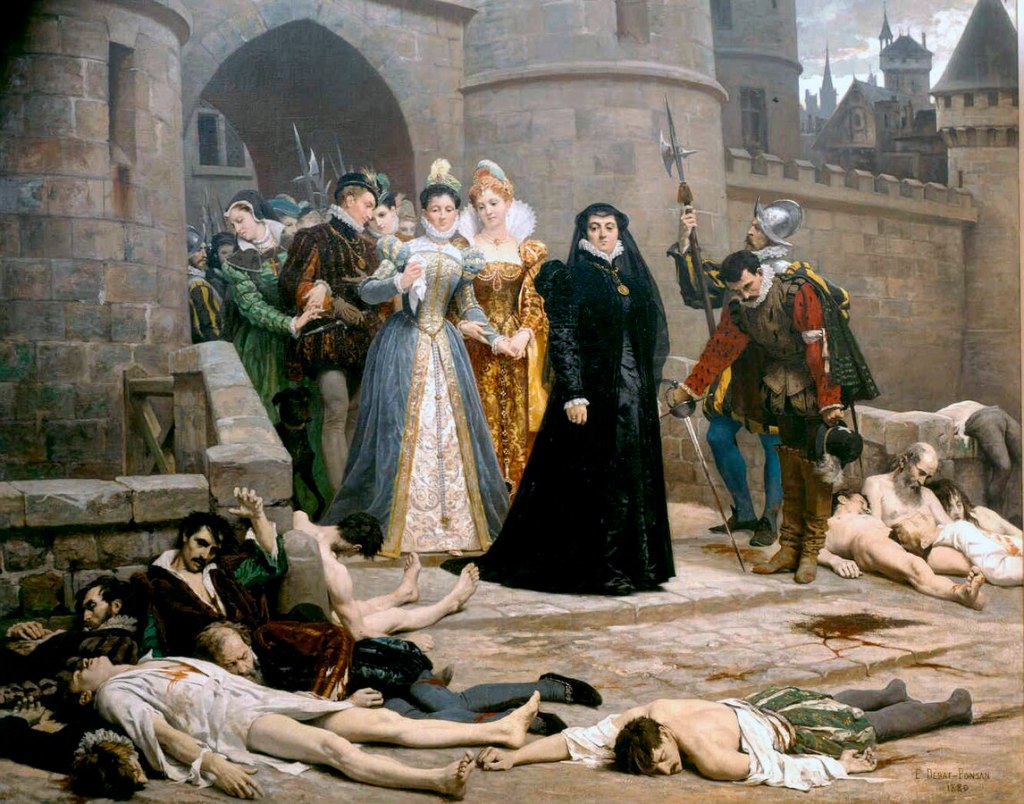
The morning of August 24th, 1572, Saint Bartholomew’s Day. The Queen Mother of France, Catherine de’Medici, emerges from the gates of the palace of the Louvre to confront the aftermath of one of the most horrific events in early modern history, the massacre of thousands of Protestant Huguenots by the Catholic population of the city. The Italian-born queen, dressed all in black, looks haughtily down upon the bodies, her expression chilly and remote. The courtiers crowded behind her seem more distressed, one lady holding a handkerchief and grasping the wrist of her companion, while another appears about to swoon. The bowing male courtier has blood on his sword, so we can assume that he has participated in the previous night’s events.
The bodies are those of French nobles and their servants, people whom she would have encountered regularly in the vast palace of the Louvre. They have been executed at her order, their bodies stripped and tossed into the street. What the queen mother might not have known is that this awful scene has been repeated all over the city, as the limited purge of the Protestant nobility sparked a wave of sectarian killings.
The number of dead whose corpses lay littered all over Paris that morning is not known; estimates vary between two and three thousand. But the massacre triggered a wave of anti-Protestant killings across France, and some estimates put the total death toll as high as ten or even twenty thousand. It was a seismic event in French history, and one that was to have long-lasting consequences.
What triggered this orgy of rape and murder? The answer to that lies in a civil war, a marriage, and an attempted assassination.
First, the war. France was a staunchly Catholic country, but since the 1530s, there had been a growing population of Calvinist-inspired Protestants, known in France as Huguenots. They were concentrated in the southern and western parts of the country, though there was also a substantial population in Paris itself. Tensions between the two religions grew, and each attracted adherents from among the French nobility, as well as among the common people. When King Henry II died in 1559, a power struggle ensued between the Catholic and Protestant noble families. A series of civil wars broke out that were to last for more than thirty-five years, the third of which had been concluded (temporarily, as it turned out) in August 1570.
Which brings us to the marriage. The peace was a precarious thing, with many Catholics refusing to accept it. But the king, Charles IX, and his mother, Catherine de’Medici, sought to reconcile the factions by allowing various Protestant nobles to return to court – in particular Admiral Gaspard de Coligny, the leader of the Huguenots, of whom more later. The Queen Mother also proposed that her daughter Margaret marry Henry of Navarre, the son of Queen Jeanne d’Albret of Navarre, another leader of the Protestant nobility (Navarre was a small independent kingdom in France’s south-west). The marriage was set for 18th August 1572.
Though the wedding was deeply unpopular among Catholics, it was greeted with joy by the Huguenots, who flooded into the city to join in the festivities. Paris was strongly Catholic, and its clergy soon whipped up anti-Protestant sentiment, raising tensions on the streets among a population that was already discontented because of poor harvests and rising taxes. As for the court, it was deeply divided, and most of the Catholic nobles planned to boycott the wedding.
Nevertheless, it went ahead without incident. But Admiral Coligny remained in Paris for a few days afterwards to negotiate some details related to the peace treaty; on the 22nd, he was shot by a would-be assassin, a Catholic noble named Charles de Louviers. The admiral, though wounded, survived the attempt, while the assassin escaped in the confusion. Exactly who was behind the attempt has never been clear. The obvious culprits were the Guise family, the leaders of the Catholic faction, but suspicion also fell on the Queen Mother, supposedly because she was worried about the influence that Coligny had over her son, King Charles.


Whoever was behind it, the assassination attempt was the spark that set the bonfire alight. Fearing a Protestant uprising, and aware that Coligny’s brother-in-law had four thousand soldiers camped just outside Paris, Catherine and the king made the extraordinary decision to eliminate the Huguenot leaders. Since there are no records of the meeting at which this decision was taken, it is not certain exactly who was to be targeted, but the numbers certainly ran into the dozens. At the same time, the authorities were instructed to close the city gates and arm the citizenry against a possible uprising.
The ringing of the bells at the royal church of Saint-Germain l’Auxerrois in the early hours of the morning was the signal for the killing to begin. The king’s guards expelled those Protestant nobles who were living in the Louvre, murdering them and their retainers out in the street. The Duke of Guise led a party to find the injured Admiral Coligny, killing him and throwing his corpse out of the window.
The queen mother and the king had no doubt hoped that would be the end of the bloodletting, but they had unwittingly started a conflagration that they could not control. The citizens of Paris took matters into their own hands and began indiscriminately killing any Huguenots they could find. Over the next three days, they were hunted from their homes, killed and their bodies thrown into the Seine. Thousands came to a grisly end, men, women and innocent children, and the chaos soon spread to the countryside, provoking further pogroms.
Eventually, once he had regained control of the city, King Charles held a mass and announced that he had ordered the massacre in order to thwart a plot against the royal family. At first, Catholics within and beyond France’s borders rejoiced at what they saw as an act of divine retribution against heretics; Phillip II of Spain supposedly laughed at the news – “for the only time on record”, a chronicler sardonically said. But as the sickening scale of the slaughter became known, there were second thoughts and revulsion within both Catholic and Protestant worlds. Catherine’s policy of trying to remain on good terms with the Protestant powers almost collapsed. Queen Elizabeth’s envoy to France, Sir Francis Walsingham, barely escaped with his life and returned to London to give lurid reports to the English court, hardening even further English attitudes against the Catholic powers of Europe.
Sadly, our modern world has seen all too many events like the St Bartholomew’s Eve Massacre, but in the 16th Century, it must have come as a thunderbolt. Europe had seen war and savagery aplenty, but this seemed beyond the pale, and it left a lasting imprint upon the minds of Europeans everywhere, and for a long time after. Christopher Marlowe was the first of many playwrights to tell the story on the stage, and it featured in many subsequent plays, novels and other tracts. It was depicted in paintings, Meyerbeer featured it in his opera Les Huguenots, and the event was dramatised in films such as Queen Margot (1994).
Who was responsible for unleashing this hideous terror upon the streets of France? Tradition ascribes the most responsibility to Queen Catherine de’Medici, who is usually portrayed as a ruthless manipulator of a weak-willed son. However, this view is simplistic and has been abandoned by many modern historians. While it is true that the queen mother and the king authorised the arrest and execution of the Huguenot leadership, the drivers of the action were the various Catholic noble families who were jockeying for power behind the scenes. The French monarchy at the time was in a very weak position, all but bankrupt and dependent on the support of the nobles, particularly the Guise family. But whatever Catherine and Charles intended, it seems probable that they did not realise what a powder-keg Paris was at the time and were as shocked as anyone else when the scale of the massacre became apparent.
Like so many historical events, the truth surrounding the massacre can never truly be known. But it has resounded down through the ages as a particularly horrific example of the way in which sectarian antipathies can so easily be inflamed into hatred and thence into violence.
 Anthony R Wildman