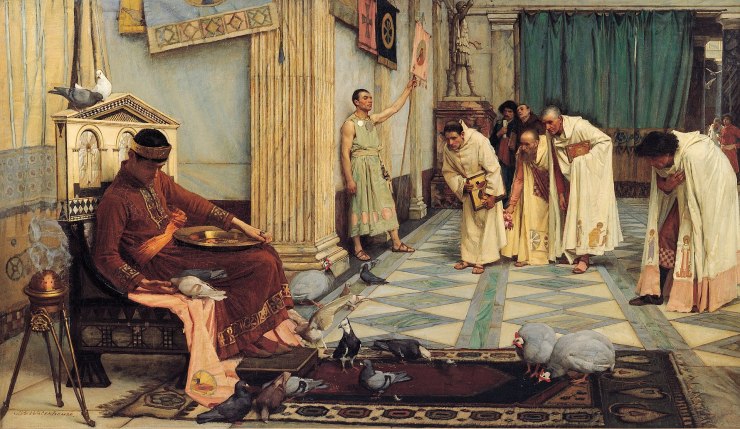
Honorius is one of those Roman Emperors who, when his name is remembered at all, is categorised as one of the ‘bad emperors’, though it would be more accurate to say that he was mostly unfortunate. Born in 384 CE, he was the son of one of Rome’s greatest rulers, Theodosius I. When he died in 395, the empire was divided into two, with Honorius becoming emperor of the Western Empire, and his brother Arcadius ruling the East. Though neither brother knew it at the time, the two halves of the Roman polity would never reunite.
At the time of his accession, he was just eleven years old. Ordinarily, such a young age might have been a recipe for civil disaster, and, in all probability, a short life for the boy who now wore the imperial diadem. But fortunately for him, Theodosius had left him in the care of a guardian, a remarkable man named Stilicho. The son of a Vandal father and Roman mother, Stilicho was Theodosius’ most trusted general, and a man of the most upright character.
Stilicho’s military skills were put to test after test during the early years of Honorius’ reign, as the empire was beset by barbarian invasions in Gaul (modern France), Italy and Spain. First there was an uprising in Africa, then Alaric led his Visigoths on the first of a series of invasions of Italy, which was beaten back only with great difficulty. The Vandals, Alans, and Suebi crossed the Rhine and invaded Gaul in 405, forcing Honorius to withdraw troops from Britain, which in turn led to unrest and yet another uprising in that distant province. By 409 the barbarian tribes had crossed the Pyrenees into the province of Hispania.
But it was the Visigothic invasion of Italy that was the most traumatic event of these early years. Milan became untenable as the capital of the Western Roman Empire (Rome’s status having long ago been downgraded as being too far from the all-important frontiers), and Honorius had no choice but to flee and relocate his court to Ravenna, which became the capital of the Western Empire, a status it retained for most of the fifth century.
Stilicho, meanwhile, fought campaign after campaign to defend the empire against these incursions and rebellions, and where military might did not work, he used massive bribes to encourage the various tribes to return home. Fine leader though he was, he had, inevitably, enemies at court who sought to bring him down. Despite trying to shore up his position by marrying his daughters to the young emperor (first Maria and then, after she died in 407, Thermantia), one of Honorius’ ministers, a man named Olympius, convinced the emperor that Stilicho was plotting to overthrow him.
Matters came to a head in August 408, when Honorius, in one of the most dishonourable moments of his principate, had his father-in-law arrested and executed. Barely a month later, Alaric was at the gates of Rome once more and had to be bought off with a massive bribe of five thousand pounds of gold and thirty thousand pounds of silver. Attempts to forge a permanent peace with Alaric failed when the fickle emperor reversed his support for the negotiations; an enraged Alaric invaded once again, besieged Rome, and when someone opened a gate to let him in, sacked it. Rome’s importance as a strategic centre might have greatly diminished, but the psychological blow of the sack was immense.
Throughout the rest of his reign, Honorius faced more rebellions in Britain, Spain, and Gaul. However, he eventually found a competent replacement for Stilicho in Constantius, who successfully suppressed most of the rebellions and repelled the invasions, and whom he later made his co-emperor for a time. Honorius died in August 423, aged thirty-nine, leaving behind no heirs.
Honorius appears to have been a rather flighty and indecisive ruler, unable to forge his own path and dependent from a young age on advisers whom he did not always choose wisely. Yet one wonders whether any emperor, even the most gifted, could have withstood the waves of barbarian invasions that swept over Roman territories during his reign. The Western Empire was greatly overstretched and, as history knows, ultimately doomed. Rome’s legacy would eventually be forced to retreat to the more compact Eastern (Byzantine) Empire.
Yet there are glimpses of an interesting humanity behind this calamitous tale. Honorius had his quirks; he forbade the wearing of trousers throughout his dominions, for instance, and he ended gladiatorial games after the martyrdom of a Christian monk named Telemachus, who died while protesting a gladiatorial fight.
But his most famous characteristic comes from a tale told by the historian Procopius, who wrote that:
‘The Emperor Honorius in Ravenna received the message from one of the eunuchs, evidently a keeper of the poultry, that Rome had perished. And he cried out and said, ‘And yet it has just eaten from my hands!’ For he had a very large cock, Roma by name; and the eunuch, comprehending his words, said that it was the city of Rome which had perished at the hands of Alaric, and the emperor, with a sigh of relief, answered quickly: ‘But I thought that my fowl Rome had perished.’ So great, they say, was the folly with which this emperor was possessed.’
It is from this story (which is probably apocryphal) that John William Waterhouse drew inspiration for his 1883 painting. Imagining that Honorius was indeed a bird fancier, he shows the young emperor nonchalantly feeding his chickens and pigeons, seemingly uninterested in the obsequious courtiers bowing before him. They are clearly Christian priests, perhaps a delegation from the Pope. The atmosphere of intrigue is conveyed by the disdainful look on the face of a servant, and the presence of courtiers in the background whispering to each other behind their hands. It is, I think, a masterful example of historical genre painting by an artist whose imagination is matched by his knowledge of history. It used to hang, by the way, in the Art Gallery of South Australia, though I understand that it has been taken down for restoration.
If, like me, you are wondering what might be going on in the minds of the various figures in the picture, you can download my short story inspired by the picture here. I’d love to know what you think!
 Anthony R Wildman