A Massacre in Madrid
In the early hours of May 3, 1808, the French Army lined up Spanish civilians against a hillside wall on the outskirts of Madrid and shot them dead by the dozen. No trial, no defence, no reprieve—just a cold, methodical execution in the name of imperial order.
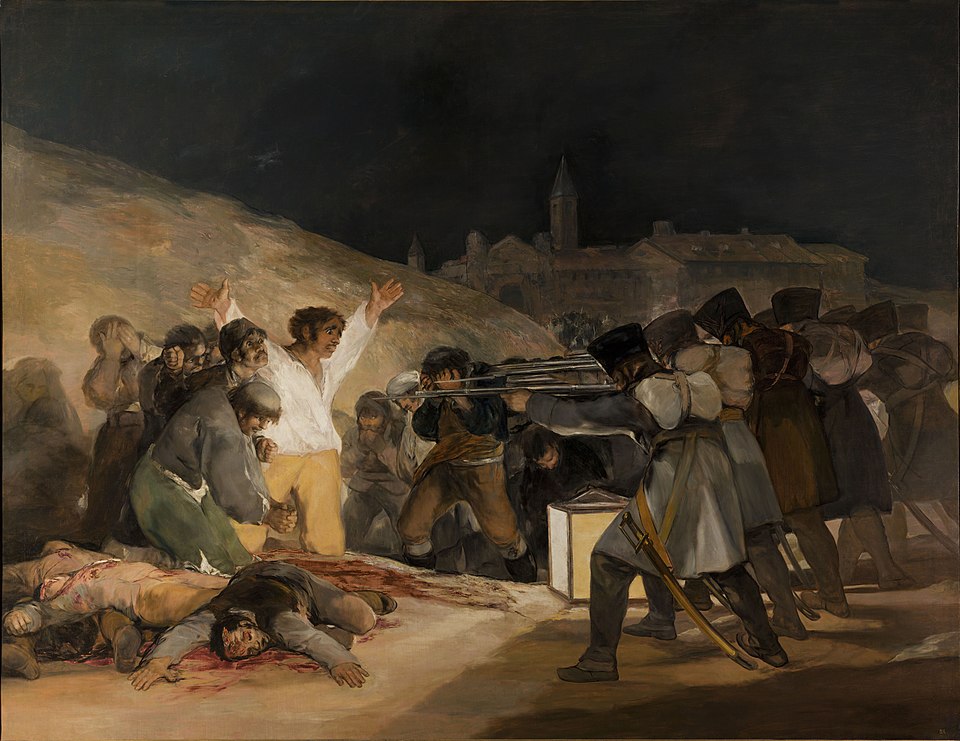
This is the moment captured in Francisco Goya’s The Third of May 1808. But the painting doesn’t just document an atrocity. It makes us live it. With theatrical chiaroscuro and raw human agony, Goya tears away the veil of patriotic myth and shows us what war truly looks like when the trumpets fall silent.
But to understand the power of this image, we need to understand the day before.
The Rising
On May 2, word spread through Madrid that members of the Spanish royal family were to be removed from the city and taken to France. Charles IV had already abdicated under pressure from Napoleon, and his son Ferdinand VII, the heir, had been lured across the border and effectively taken prisoner. Now, the French intended to take the last remaining royals—particularly the young Infante Francisco de Paula—out of reach.
It was a provocation too far.
An angry crowd gathered at the Royal Palace. What began as a protest turned violent when French troops opened fire. The uprising quickly spread across the city. Armed with knives, stones, and the occasional musket, ordinary madrileños—workers, priests, women—fought against heavily armed French soldiers in the streets. The violence was brutal, chaotic, and largely spontaneous.
Napoleon’s brother-in-law, General Joachim Murat, who commanded the French forces in Madrid, responded with characteristic efficiency: he declared martial law and ordered that anyone found bearing arms—or even suspected of resisting—be executed without trial.
The Morning After
Goya’s painting shows what happened next.
In the early hours of May 3, dozens of Spaniards, arrested during or after the uprising, were marched to a patch of open ground near Príncipe Pío Hill, just outside the city. There, under the dim light of lanterns, they were executed by firing squad in small groups.
Some were soldiers. Most were not.
We don’t know all their names. Some were priests, suspected of inciting rebellion. Others were peasants and workers caught up in the melee. What they shared was not guilt but misfortune: being in the wrong place, resisting the wrong empire.
Goya’s Witness
Goya was not at the executions. But he lived through the occupation. He saw the blood in the streets. He heard the rumours. He may even have known some of the dead. And in 1814, after the French were driven out, he painted what he understood to be the truth—not the tidy version in official reports, but the screaming, shaking, godless horror of mass murder.
At the centre of The Third of May, a man in a white shirt kneels, arms flung wide in a gesture that could be prayer or surrender, his face twisted in terror. Behind him lie corpses, and before him, the next to die wait their turn. To the right, a row of French soldiers fires in eerie unison, their faces hidden, their bodies mechanical.
It is not a battle. It is an execution. And in that, it is timeless.
Unlike the neoclassical canvases of the time, Goya’s victims have no heroic poses, no laurels, no idealised beauty. They are dirty, panicked, defenceless. Their killers are not demons, either—just men obeying orders. That is the horror.
And that is the genius of the painting: it refuses to moralise or mythologise. It doesn’t offer redemption. It simply shows us what happened—what always happens—when the machinery of empire crushes the people beneath it.
The Legacy
The executions of May 3 were just the beginning. Across Spain, Napoleon’s invasion would spark a brutal and drawn-out guerrilla war. French troops would commit further massacres; Spanish insurgents would return the favour. Civilians, as always, suffered the most.
But The Third of May 1808 remains one of the first works of art to capture the human cost of that suffering without embellishment. It has influenced generations—from Manet and Picasso to war photojournalists and filmmakers—but more than that, it stands as a moral reckoning.
In a world still full of firing squads and frightened civilians, it demands that we look and remember.
 Anthony R Wildman