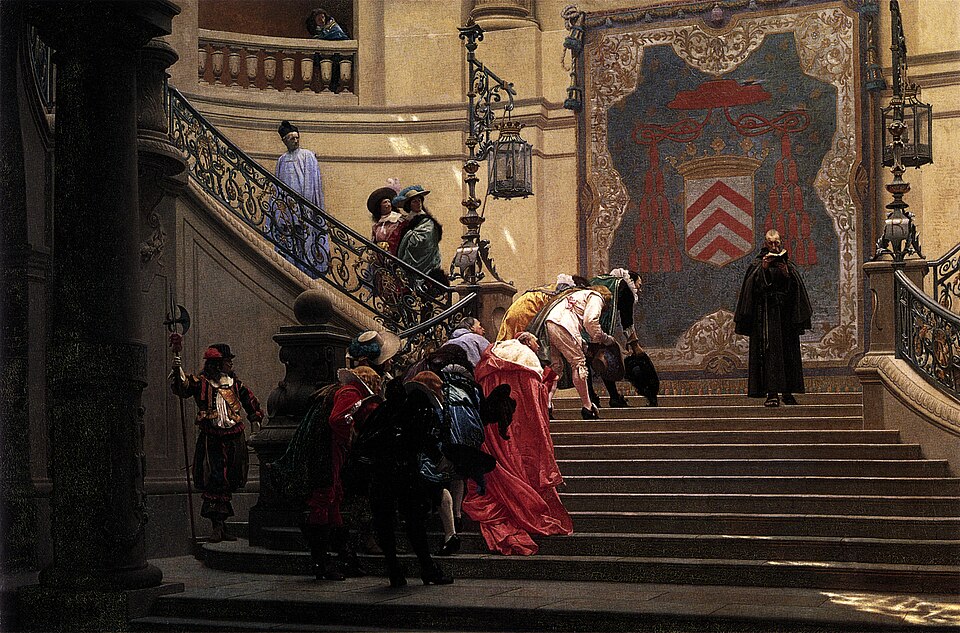
It is a striking image: the humble priest, dressed in the plain grey robe and sandals of a humble friar, descends the stairs at the Palais-Royal in Paris, absorbed in the prayer book he holds in his hands and completely oblivious to the obsequious gestures of the richly dressed courtiers. There is even a red-robed cardinal among the supplicants, though the priest in white at the top of the stairs wears a more disdainful look as he turns back towards the friar, as though, now that he is safely past the other man, he can allow his true feelings to show.
Powerful courtiers in any age do not show deference to anyone other than someone mightier than they. Yet the figure towards whom they bow is just a priest, not anyone’s idea of power. So who is he?
His name is Father Joseph du Tremblay. Born in 1577 in Paris and given the baptismal name of Francois Leclerc du Tremblay, he was from a noble family, inheriting the title of Baron de Maffliers. After receiving a classical education, he toured Italy and then became a soldier. He fought in the Franco-Spanish War of 1595-98, at the end of which he accompanied the envoy sent to the court of Elizabeth I of England, greatly enjoying the experience of English intellectual life in the age of Shakespeare.
And then, quite suddenly, he turned his back on the secular life and entered the Capuchin priory at Orleans. The Capuchins were an order of Franciscan friars who sought to return to the ideals of Saint Francis of Assisi by living simply and devoting themselves to God. Embracing the religious life with great fervour, he became a notable preacher and reformer.
That might have been his career, but for a chance meeting with a reforming bishop named Armand Jean du Plessis – better known to history as Cardinal Richelieu. The two men, despite having different outlooks on life and politics, became friends. The bishop was then in exile in Avignon following the palace coup in which King Louis XIII had ended the de facto rule of his mother, Marie de’ Medici. Tremblay (known by his monastic name, Father Joseph) was instrumental in lobbying for the cardinal’s recall to Paris.
Richelieu rapidly consolidated his position, soon becoming the king’s chief minister, with the faithful Father Joseph close by. The cardinal’s unswerving policy was to enhance the power of the French monarchy by suppressing the power of the feudal nobility and stamping out the rebellious Protestant Huguenots. In foreign policy, he did everything possible to ensure that the Thirty Years War would continue to rage in order to weaken the Habsburg grip on Europe.
In all of this, Father Joseph was Richelieu’s faithful right-hand man. Though nominally no more than a secretary, he was employed by the chief minister in many missions, both overt and clandestine, and was always a close and powerful counsellor behind the scenes. He became known as the ‘grey eminence’, a nickname derived from the color of the habit that he wore and the formal title (’eminence’) with which the cardinal was addressed. The phrase – in French éminence grise – has come to mean a powerful adviser who operates covertly in an unofficial capacity.
Yet, despite all his worldly concerns, Father Joseph maintained an austere and devout personal discipline, never embracing personal vanity, and spent much of his day in prayer. This dichotomy is well caught in Gérôme’s painting in the contrast between the finery of the courtiers and the simplicity of Father Joseph’s clothing. It is as if he not only disdains their worldliness, but he is entirely divorced from it.
About the painter: Jean-Léon Gérôme (1824-1904) was a French painter and sculptor in the style now known as academicism. The range of his works includes historical paintings, Greek mythology, Orientalism, portraits, and other subjects. Gérôme is considered among the most important painters from the academic period and was one of the most successful artists of the Second Empire.
He was also a teacher with a long list of students, including Mary Cassatt and Thomas Eakins, among others.
 Anthony R Wildman