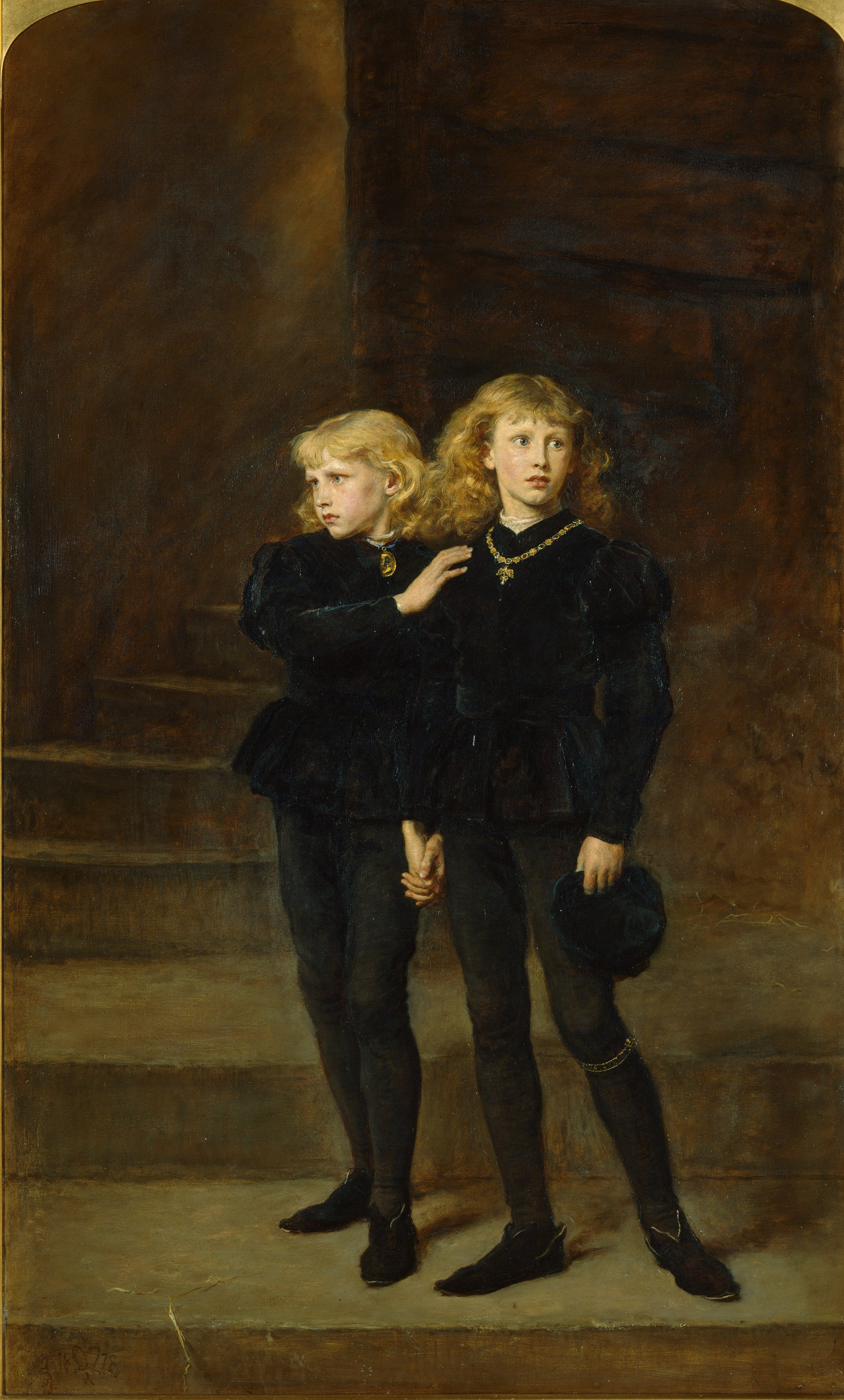
Few images in British history are as haunting—or as unresolved—as this picture of two young boys, good-looking to the point of prettiness, yet wearing expressions of deep apprehension.
They are the two sons of the English king Edward IV. When Edward was crowned in 1461, it seemed that the long ‘Wars of the Roses’ between the two claimant families to the English throne, the House of York and the House of Lancaster, was finally over. Edward, a young man still, looked set for a long reign. But then in 1470, he faced a rebellion, led by the Earl of Warwick, and he was forced into exile. Returning less than a year later, he defeated Warwick at the Battle of Barnet and then killed the last Lancastrian heir to the throne at Tewkesbury. York was triumphant.
Edward had married Elizabeth Woodville in 1464. It seems to have been an affair of passion, for she was not noble, coming from a minor Lancastrian family of middling rank. What she did bring with her was a horde of grasping relatives and great fecundity. She gave Edward ten children, seven of whom were still living when the king died in 1483, aged just forty. Five were daughters, and two were the boys shown in the picture. The elder was named Edward after his father, and he automatically became King Edward V on his father’s demise; he was just twelve years old. The other was his brother, Richard of Shrewsbury, a nine-year-old.
The king’s death was completely unexpected. Though physically strong, he had grown gluttonous with the benefits of peace, which perhaps contributed to his end, although the actual cause of death is not known. What is certain is that he had failed to make sure that his son’s succession would go smoothly.
True, he had appointed his faithful younger brother Richard, the Duke of Gloucester, as Lord Protector. Richard would rule the kingdom until such time as young Edward came of age. But a royal minority was a perilous thing at a time when almost all power derived from the person of the king. Almost immediately, some of the queen’s relatives seemed to attempt a coup by taking control of the boy (who was then at the castle of Ludlow) in order to escort him to London. Richard, smelling a plot, hurried south from his own base in York and had them arrested so that he could take the king to London himself.
The new king and his brother were lodged in the Tower of London, then more royal residence than grim prison. Plans were commenced for Edward’s coronation. But the Protector repeatedly postponed it, and then, like a clap of thunder out of a clear summer’s sky, came the bombshell ‘discovery’ that the late king had in fact been contracted in marriage with a woman named Eleanor Butler before he married Elizabeth Woodville. Consequently, that marriage was declared null, and the two boys were made illegitimate – and therefore ineligible to sit on the English throne. Gloucester was proclaimed and crowned as King Richard III instead.
Richard’s motives for this piece of chicanery are not clear. It was true that the recent history of royal minorities had not been happy; the reign of the boy-king Richard II had kicked off the wars, and the minority of Edward IV’s immediate predecessor, Henry VI (he had become king at just nine months old), was just as unhappy. On the other hand, Gloucester had been bone-loyal to his brother throughout his life, and to disinherit his sons seems entirely out of character. Most likely, it was a matter of realpolitik. He probably knew that a boy as young as Edward could easily be manipulated, to the detriment of the realm as a whole, not to mention the risks to his own life in a murderous age where quarrels between nobles could easily end in bloody war.
Whatever his reasons, Richard seems to have persuaded the English nobility and parliament to make him king in Edward’s place. It is what happened next is mysterious, and has placed a stain against Richard’s name ever since.
At first, nothing seemed amiss. The country seemed to accept the new king, and the two boys were healthy enough, remaining in the Tower where they lived in the royal apartments. But gradually they were seen less and less, eventually disappearing entirely from view by late summer 1483.
The assumption was that they were murdered at some point, though exactly by whom and at whose orders is the subject of a great deal of historical speculation. The obvious culprit is Richard himself, and this was certainly the view of Thomas More, writing fifty years later, who asserted they were smothered to death with their own pillows. Shakespeare took this account and ran with it, creating along the way one of the greatest plays in English literature and an unforgettable characterisation of Richard.
Having a couple of potential claimants to his throne still living would not have been a comfortable thought for him, and bumping them off would be a simple solution, probably not even something for which he would have been much blamed. Indeed, there seems to have been very little interest in the fate of the two boys at the time.
But there are other suspects. It is equally possible that they survived Richard’s reign, brought to an untimely end by the first Tudor king, Henry VII, at the Battle of Bosworth in 1485. It is quite possible that they were assassinated on Henry’s orders. He, after all, had a very powerful motive to remove any possible Yorkist claimant to the throne, since his own right to it was very shaky indeed.
Other suspects have been put forward from time to time, the most prominent of which was Henry Stafford, Duke of Buckingham, either to rid Richard of a problem or for some purpose of his own.
It is also possible that they did not die in the tower at all; Henry Tudor’s reign was plagued by pretenders who appeared on a regular basis claiming to be the younger of the two princes; though it seems far-fetched, it is not impossible that either Lambert Simnel or Perkin Warbeck was, in fact, Prince Richard.
In 1674, workmen rebuilding a part of the Tower discovered the bones of two children, which King Charles II ordered to be placed in Westminster Abbey as the remains of the two princes. They were disinterred in 1933, when it was discovered that the skeletons were incomplete, and that they had been buried with some animal bones, something that would have been an odd thing to do with a pair of royal corpses. Another pair of skeletons was discovered in Windsor Castle in 1789, in circumstances that led to the belief that they might have been the two princes, but, again, there is no way to prove that definitively.
However they died, and wherever their bodies ended up, the story of the death of these two young boys is the stuff of tragedy. In his painting, Millais captures them at the moment when the murder has not yet been committed, but the victims sense that something bad is about to happen. They are shown together in a dim interior, alert and anxious—suggesting they sense danger but do not yet understand it. Edward stands protectively behind Richard, reinforcing both their innocence and vulnerability. The heavy shadows and enclosed space evoke imprisonment without showing violence. It is a great picture in the true pre-Raphaelite style, historically detailed and filled with a sense of drama.
Rather than depicting their deaths, Millais captures something more powerful: the human moment before history closes in, and in so doing creates a haunting image.
 Anthony R Wildman