Introduction
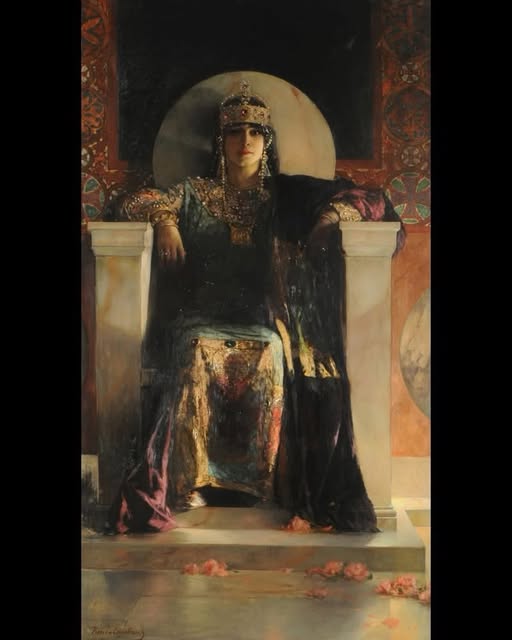
Few paintings capture the intoxicating blend of power, sensuality, and mystique quite like The Empress Theodora on her Throne by Jean-Joseph Benjamin-Constant. Created in the late 19th century, the work is less a strict historical reconstruction than a richly imagined vision of one of history’s most formidable women: Theodora, wife of Justinian I.
Who Was Theodora?
Theodora (c. 500–548 CE) rose from humble—and, by elite standards, scandalous—origins to become Empress of the Byzantine Empire. But her early life was far removed from imperial splendour. She is believed to have been the daughter of a bear-keeper at the Hippodrome in Constantinople. As a young woman, she worked as an actress, an occupation associated at the time with low social status and moral suspicion. The historian Procopius—a not altogether reliable interlocutor—says she worked as a prostitute.
She seems to have travelled to North Africa as the concubine of the governor of Cyrenaica; Procopius says their relationship dissolved as a result of a quarrel, and Theodora then travelled on to Alexandria before returning to Constantinople.
Her life changed dramatically when she met Justinian, then heir to the throne. Their marriage required a change in imperial law, as actors were barred from marrying into the elite. When Justinian became emperor in 527, Theodora was crowned empress alongside him.
The Byzantine Empire in Her Time
Theodora lived at the height of Byzantine ambition. Under Justinian, the empire sought to reclaim the lost territories of the Western Roman Empire—campaigns that brought parts of Italy, North Africa, and Spain back under imperial control.

Constantinople itself was the glittering centre of this world: a city of immense wealth, elaborate court ritual, and intense political intrigue. The emperor was seen as God’s representative on earth, and the court functioned as a stage upon which power was constantly performed.
Yet this splendour masked fragility. The empire was strained by war, plague, and internal division. It was a world where authority had to be asserted visibly and relentlessly.
Theodora the Empress
Theodora was no mere passive consort. From the start, she helped her husband make decisions, participated in state councils, and had great influence over him. Justinian sought her advice and called her his “partner in my deliberations”. She helped stabilise Justinian’s rule at critical moments, influenced legislation, and shaped religious policy. As empress, she championed laws improving the status of women, including protections against forced prostitution and expanded divorce rights. She also played a role in religious disputes, particularly supporting Monophysite Christians against the imperial orthodoxy. Few women in the ancient or medieval world have ever exercised comparable power.
Her most famous moment came during the Nika Riots, which were sparked by street violence between the supporters of the two chariot racing factions, but morphed into a serious challenge to imperial power. As the city burned and Justinian considered fleeing, Theodora reportedly delivered a steely speech insisting that “royal purple makes a fine burial shroud.” Her resolve helped stiffen imperial resistance, and the revolt was brutally suppressed.
She seems to have been a very complex character. Pious yet ruthless and cruel, flexible and obviously intelligent, vindictive but loyal, particularly to her husband, inspiring loyalty and fear in equal measure. Just as importantly, she embodies the permeability—however rare—of social boundaries in Byzantium. Her rise from the margins to the pinnacle of imperial society is extraordinary, even by modern standards.
The Painting.
Benjamin-Constant, known for his fascination with opulence and the exotic, presents Theodora as a figure of almost overwhelming presence—imperious, dangerous, and utterly self-possessed. The painting is more theatre than documentary image.
Theodora is presented frontally, dominating the canvas. Her gaze is unwavering, almost confrontational. The richness of the setting—jewels, gold, intricate textiles—creates an atmosphere of overwhelming luxury, but also of suffocating control. This is a world where power is inseparable from display.
There is little softness here. Unlike traditional depictions of queens or empresses, Theodora is not idealised as gentle or maternal. Instead, she is formidable, even intimidating. The painting reflects 19th-century fascination with the “exotic East,” but it also captures something deeper: the performative nature of imperial authority.
In this sense, Benjamin-Constant may be closer to the truth than he realised. The real Theodora ruled in a court where image, ritual, and spectacle were essential tools of power. His painting exaggerates, certainly—but it exaggerates in the right direction.

