It is May 1800, and Napoleon Bonaparte is leading a French army across the Alps into northern Italy in one of the most audacious military operations of his career. The campaign would culminate in a dramatic victory over the Austrians at the Battle of Marengo, helping consolidate his position as ruler of France.
The crossing was immortalised by the great visual chronicler of the French Revolution, Jacques-Louis David, in one of the most famous portraits of Napoleon ever painted. David depicted the young general astride a magnificent rearing stallion, his cloak billowing in the wind, pointing resolutely towards the summit. It was an image of heroic leadership, portraying Napoleon as a man of destiny.
But, brilliant though the painting is, the reality was much more prosaic. Napoleon actually made the crossing on the back of a mule, led by a local mountain guide. There was no rearing stallion, no dramatic gesture towards the heavens, and little glamour in the business of getting an army across a snow-covered mountain pass.
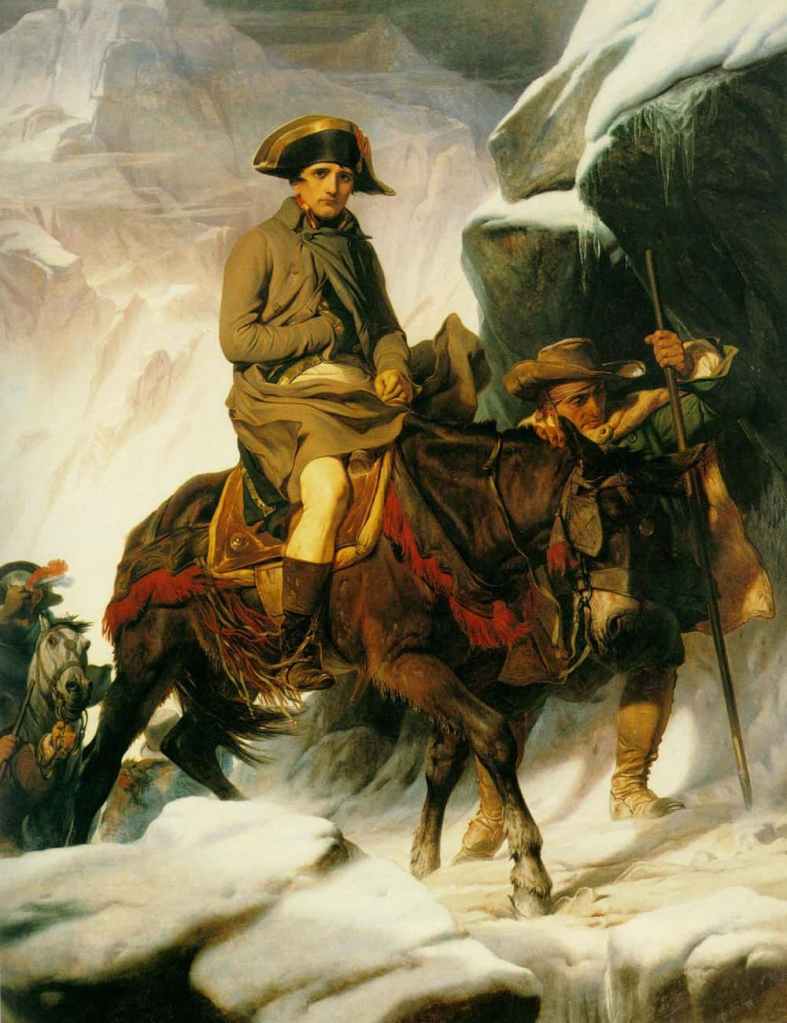
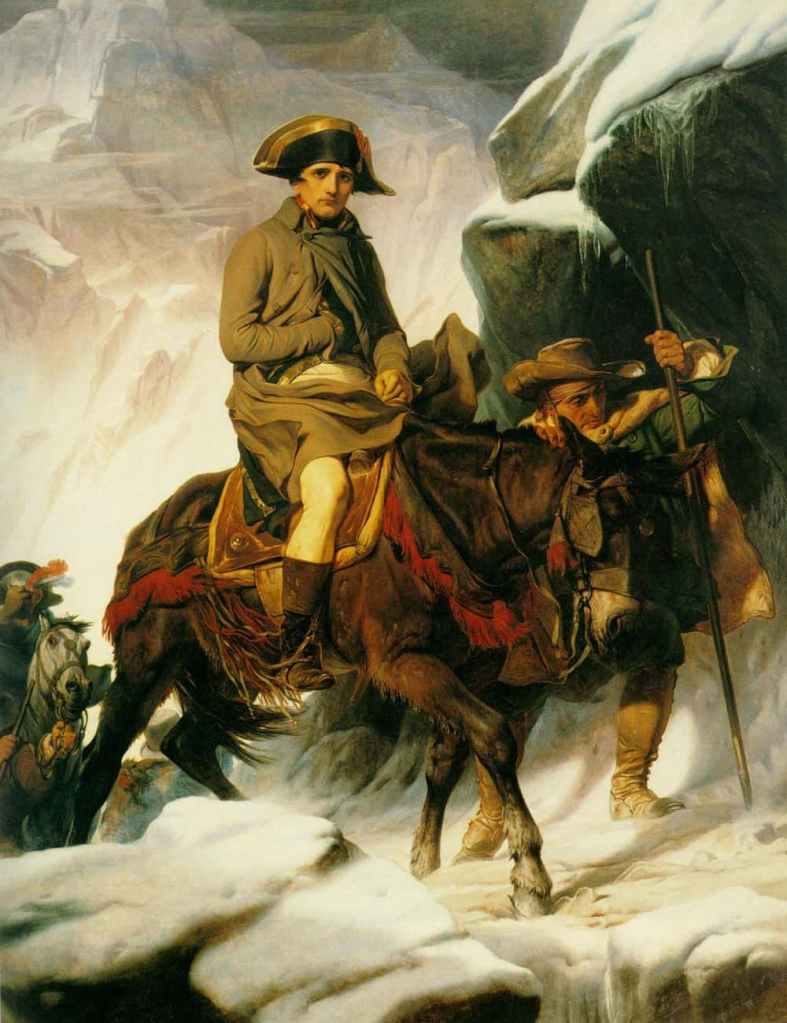
It is this reality that the French painter Paul Delaroche represented, almost half a century later, in his Bonaparte Crossing the Alps, painted in 1848. It depicts a rather miserable-looking Napoleon, wrapped against the cold and perched uncomfortably on his mule as it picks its way through a forbidding mountain landscape.
The Historical Background: Napoleon’s Second Italian Campaign
In the spring of 1800, Napoleon Bonaparte was First Consul of the French Republic, having seized power in a coup d’état in November 1799.
Although he was now the dominant figure in French politics, his position was far from secure. France had been at war with much of Europe for nearly a decade, and the country’s military fortunes had deteriorated. The Austrians had recovered much of northern Italy, reversing Napoleon’s spectacular victories in his first Italian campaign of 1796–97, and by the spring of 1800, the French forces remaining in Italy were under severe pressure. General André Masséna was besieged in Genoa, while the Austrians, commanded by General Michael von Melas, were threatening to invade southern France.
Napoleon needed a decisive victory to restore France’s military position and to strengthen his own political authority. His solution was characteristically bold. Rather than attack the Austrians directly from France, he would lead an army across the Alps, descend into northern Italy and strike at the enemy’s communications and lines of retreat.
The plan depended upon speed, surprise and an extraordinary feat of military logistics. An army of tens of thousands of men, together with horses, wagons, artillery and supplies, would have to be transported across some of the most difficult terrain in Europe, through the Great St Bernard Pass between Switzerland and the Italian region of Aosta.
The pass, more than 2,400 metres above sea level, was still covered in snow when the French advance guard began the crossing on 14 May 1800. Napoleon himself traversed the pass on 20 May.
The difficulties were formidable. Men struggled along narrow, icy tracks, frequently exposed to bitter winds and dangerous precipices. The artillery posed a particular problem. Guns were dismantled or secured inside hollowed-out logs and hauled across the mountains by teams of soldiers and animals.
Napoleon, meanwhile, was carried across the most treacherous sections of the route on a mule. Far from being an indignity, this was a matter of practicality: mules were far better suited than horses to negotiating the steep and slippery mountain paths. According to accounts of the crossing, his guide was a local man named Pierre-Nicolas Dorsaz. One story tells how the mule slipped at a particularly dangerous point on the route and Dorsaz managed to prevent it from falling into a precipice, thereby saving Napoleon’s life.
The Aftermath: Victory at Marengo
Once across the mountains, Napoleon moved rapidly into northern Italy. His arrival took the Austrians by surprise, and on 2 June, Napoleon entered Milan, which had fallen back into Austrian hands during the previous year. His advance threatened to cut off the Austrian army from its bases and communications to the east.
But not every aspect of the campaign was proceeding entirely according to plan. On 4 June, Masséna, whose resistance at Genoa had helpfully tied down substantial Austrian forces, was finally compelled to surrender. Napoleon had crossed the Alps too late to relieve him. Meanwhile, the Austrian commander, Melas, began concentrating his forces near the town of Alessandria. Napoleon, uncertain of the enemy’s intentions, dispersed parts of his army to cover various possible routes.
On the morning of 14 June 1800, the Austrians launched a major attack against the French positions near the village of Marengo, just to the east of Alessandria.
At first, the battle went badly for Napoleon. The Austrians outnumbered the French forces, and their attacks gradually drove Napoleon’s troops from their positions. By the afternoon, the French appeared to have been defeated. Melas, satisfied that victory was secured, delegated the pursuit to his subordinates.
But the battle was not over.
A French division under General Louis Desaix, which Napoleon had previously sent away on a reconnaissance mission, returned to the battlefield late in the afternoon, giving the French a badly needed reinforcement at a critical moment. Desaix’s counterattack was devastating. The Austrian forces were thrown into confusion, and what had seemed a certain Austrian victory was transformed into a French triumph, though Desaix himself was killed in the fighting.
The Battle of Marengo was one of Napoleon’s most important victories, primarily because of its political consequences. The Austrians agreed to an armistice the following day and withdrew from much of northern Italy. For Napoleon, the victory was invaluable. He had returned from Egypt amid political uncertainty, seized control of the French government, and now demonstrated that he remained the Republic’s most successful general.
In the months that followed, Marengo was celebrated as a triumph of military genius. The uncomfortable reality that Napoleon had come perilously close to defeat was largely submerged beneath the legend of his brilliance. The crossing of the Alps was an essential part of that legend.
Two Paintings, Two Napoleons

Jacques-Louis David’s famous painting was completed in 1801, shortly after the Italian campaign. Originally commissioned by King Charles IV of Spain for a gallery of great military commanders, it proved so successful that Napoleon ordered further versions, five of which were eventually produced by David and his workshop.
David’s depiction was not intended as an accurate historical record. It was a piece of political theatre, designed to establish Napoleon’s image as a heroic figure comparable to the great conquerors of the past, and everything about the composition reinforces this message. Napoleon’s magnificent horse rears dramatically, its mane streaming in the wind, while the general sits effortlessly in the saddle. His scarlet cloak billows behind him, and his outstretched arm points towards the summit, urging his troops onwards. His expression is calm and determined, seemingly indifferent to the dangers surrounding him.
At the bottom of the painting, the names BONAPARTE, HANNIBAL and KAROLUS MAGNUS (Charlemagne) are carved into the rocks. The symbolism could hardly be clearer: Napoleon was following in the footsteps of two of history’s greatest military leaders, both of whom had crossed the Alps to wage war in Italy.
Even the landscape serves a symbolic purpose. The towering mountains and threatening clouds are not so much obstacles as a dramatic backdrop against which Napoleon’s greatness can be displayed.
David was, in effect, creating the visual mythology of Napoleon.
Delaroche’s interpretation, painted nearly fifty years later, could scarcely be more different.
Gone are the rearing horse, the swirling cloak and the heroic gesture. Instead, Napoleon sits hunched on a mule, wrapped in a heavy grey overcoat, his hands tucked close to his body against the cold. His face is pale and sombre, his expression suggests weariness, concentration and perhaps even apprehension. The mule plods carefully along the narrow track, led by a rugged mountain guide who appears thoroughly accustomed to the dangerous terrain. In the background, other members of the party struggle up the mountain.
Most strikingly, Napoleon seems almost passive. Unlike David’s commanding hero, he is not leading the way. He is being led.
And yet Delaroche’s picture is not necessarily less flattering. Where David celebrates the almost superhuman general, Delaroche invites us to admire the determination of an ordinary human being attempting something extraordinary. His Napoleon may be cold, uncomfortable and vulnerable, but he is nevertheless crossing the Alps at the head of an army, preparing to undertake a campaign that will change the course of European history.
There is something quietly heroic about the contrast between the modest figure on the mule and the enormous historical consequences of his journey.
David presents Napoleon as he wished to be remembered. Delaroche attempts to show him as he might actually have appeared.
About the Artist and the Painting
Paul Delaroche (1797–1856) was one of the most successful French history painters of the nineteenth century. He specialised in dramatic scenes from history, often depicting famous individuals at moments of personal crisis or vulnerability.
Among his best-known works are The Execution of Lady Jane Grey (1833) and The Assassination of the Duke of Guise (1834). In both paintings, as in his depiction of Napoleon, Delaroche places the human experience at the centre of an important historical event.
His approach appealed to nineteenth-century audiences, who were increasingly interested in history not merely as a succession of great deeds, but as the personal stories of the men and women who had shaped the past.
Delaroche’s painting also reflected changing attitudes towards Napoleon himself.
After his defeat at Waterloo in 1815 and his death in exile on St Helena in 1821, Napoleon’s reputation underwent a remarkable transformation. Once regarded by many Europeans as a dangerous tyrant, he gradually became a figure of romance and legend. In 1840, his remains were returned from St Helena to France and interred with great ceremony at Les Invalides in Paris. The event encouraged a renewed fascination with Napoleon’s life, achievements and personal character.
Delaroche was among those fascinated by the Emperor. His painting was not conceived as an attack upon Napoleon’s reputation, but rather as an attempt to reveal the human reality behind the heroic legend.
The timing is also significant. Delaroche completed his first version of Bonaparte Crossing the Alps in 1848, a year of revolution and political upheaval in France, when the monarchy of Louis-Philippe was overthrown and the Second Republic established.
Later that same year, Napoleon’s nephew, Louis-Napoléon Bonaparte, was elected President of the Republic. In 1852 he would proclaim himself Emperor Napoleon III. Napoleon’s legacy was once again at the centre of French political life.
Interestingly, Delaroche’s versions of the painting found an enthusiastic audience in Britain, the country that had been Napoleon’s most persistent enemy. British collectors commissioned versions of the subject, reflecting the fascination that Napoleon continued to exercise even among the descendants of those who had fought against him.
The 1848 painting is now in the Louvre in Paris, while a second version, completed in 1850, hangs in the Walker Art Gallery in Liverpool.
Conclusion: History and Legend
Which of the two paintings tells us more about Napoleon?
David’s magnificent portrait captures something of the extraordinary confidence and ambition that enabled a relatively obscure Corsican artillery officer to become the master of much of Europe. It conveys the force of personality that inspired his soldiers and terrified his enemies. But it is also a carefully constructed image of political power, a deliberate exercise in mythmaking.
Delaroche’s Napoleon is smaller, less imposing and more recognisably human. He is not a demigod bestriding the mountains, but a determined soldier enduring a difficult journey in pursuit of an audacious military objective.
Both artists, however, were doing more than recording a historical episode. They were interpreting Napoleon for the audiences of their own times.
David was helping to create the legend of the great conqueror. Delaroche was exploring the man concealed beneath that legend. And perhaps the most revealing detail of all is that humble mule. In David’s painting, Napoleon appears to conquer the Alps through sheer force of will. In Delaroche’s, he crosses them through planning, perseverance and the practical assistance of an experienced mountain guide.
The second version may be less magnificent, but it reminds us that even the greatest figures in history must contend with the ordinary difficulties of the world around them.
And that is perhaps a more interesting story than the legend.

