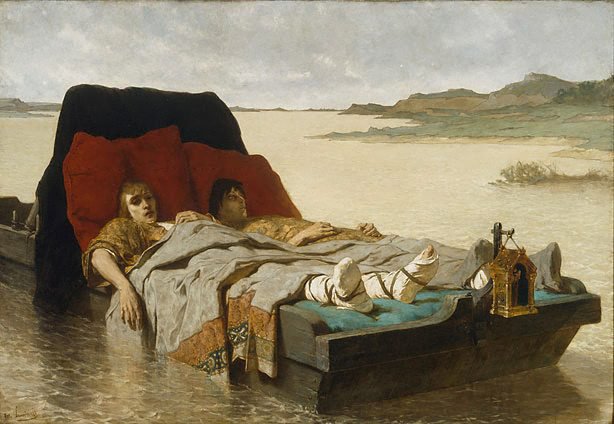
At first glance, Évariste Luminais’s The Sons of Clovis II looks like a scene of death, or perhaps of plague. Two young men lie on a strange floating bed, swaddled in blankets, their bandaged feet pointing towards the viewer. The water is still. The sky is grey. There is no rescuer in sight. A candle and reliquary at the prow suggest that this is not merely an accident, but some kind of ritual surrender.
The painting is at once beautiful and disturbing. It has the theatrical finish of nineteenth-century history painting, but its subject is medieval, barbaric and almost dreamlike: two royal sons, mutilated and set adrift on the Seine. Luminais exhibited the first version at the Paris Salon of 1880; the work now in the Art Gallery of New South Wales was bought in Paris in 1886, while a later version is held by the Musée des Beaux-Arts in Rouen.
The legend behind the painting
The story Luminais painted was known as the legend of the Énervés de Jumièges — the “enervated” or “unnerved” men of Jumièges. In modern English, the word “enervated” usually means exhausted or weakened, but here it has a much more literal and gruesome meaning. The princes have had their tendons destroyed, leaving them unable to move.
According to the medieval legend, Clovis II, king of Neustria and Burgundy, left his kingdom to go on pilgrimage or crusade to the Holy Land. During his absence, two of his sons rebelled against him and against their mother, Queen Balthild, who was acting as regent. When Clovis returned, he defeated the rebellion and had to decide what punishment was suitable for royal sons who had raised their strength against their own father.
In some versions of the story, Balthild herself proposes the punishment. Since the princes had used the strength of their bodies against the king, that strength should be taken from them. Their tendons are cut so they can no longer stand, fight or rule. Yet their parents cannot quite bring themselves to execute them. Instead, they place them in a boat without oars or rudder and commit them to the Seine, leaving God to decide their fate.
As the story goes, the current guided the boat downstream to the Abbey of Jumièges (near Rouen). The monks found the boys and took them in, nursing them back to health. The princes ultimately repented, took religious vows, and spent the rest of their lives in holiness at the abbey.
The real story of the sons of Clovis
The legend, however, is not history.
Clovis II was a real Merovingian king. He ruled Neustria and Burgundy in the seventh century and was married to Balthild, an Anglo-Saxon woman who had been enslaved before becoming queen. They had three sons: Clothar, Childeric and Theuderic. All three became kings after Clovis’s death.
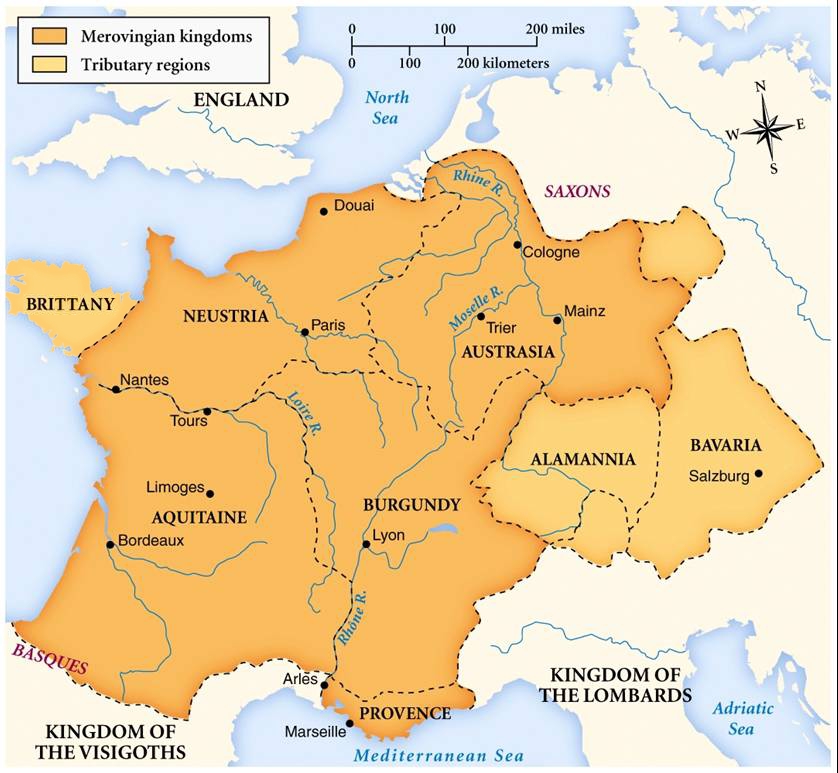
But the central events of the legend do not stand up. Clovis II did not go on crusade; the crusading movement belonged to a much later age. Nor does the chronology work. Clovis died in 657, when his sons were still children or very young. They could not plausibly have rebelled against him in the grand, armed fashion imagined by the legend. In fact, the Rouen museum dates the legend’s emergence to the twelfth century, several hundred years after the supposed events.
The actual fate of Clovis’s sons was dramatic enough, but in a different way. Clothar III succeeded his father in Neustria and Burgundy. Childeric II became king in Austrasia and later briefly ruled more widely before being assassinated in 675. Theuderic III was at different times displaced, restored and eventually became the sole king of the Franks.
Balthild, too, looks rather different in history than in the legend. Far from being remembered chiefly as a cruel mother, she was venerated as a saint. After Clovis’s death, she acted as regent for her young son Clothar III before later retiring to the abbey of Chelles. The legend of Jumièges takes real royal names and attaches them to a story that is symbolic rather than factual: a warning about rebellion, parental authority, bodily punishment and divine mercy.
About the painter and the painting
Évariste Vital Luminais was born in Nantes in 1822 and became one of nineteenth-century France’s notable painters of early French history. He had a particular taste for Gauls, Franks, Merovingians and other figures from the deep national past. In this sense, he belonged to a wider artistic and cultural movement that sought the origins of France not only in classical antiquity, but in the misty, violent world of early medieval tribes, kings and warriors.
This was fertile ground for Salon painting. The public loved large historical canvases: scenes that were dramatic, emotional and morally legible. Luminais’s The Sons of Clovis II fits that world perfectly, but it is stranger than many heroic battle scenes. There is no action. The drama lies in stillness. The princes float towards us like the living dead, their bodies immobilised, their faces pale, their raft both cradle and coffin.
Luminais chooses the moment after the violence. The punishment has already happened. The boys are not shown resisting, crying out, or being mutilated. They are shown afterwards: inert, royal, helpless. Their luxurious bedding and embroidered textiles emphasise their rank, while the rough raft beneath them makes their situation pitifully fragile. In the distance, according to the Rouen museum’s account, the dawn and the presence of Jumièges Abbey suggest salvation: the princes will be found by monks and live out their lives in holiness.
That tension is what gives the painting its peculiar power. It is not quite a martyrdom, not quite an execution, not quite a miracle. It is a punishment scene without the punishment itself; a devotional image with a strong taste for horror.
The Art Gallery of New South Wales describes the picture as a shocking example of nineteenth-century Salon painting and notes the grim effectiveness of its “cadaverous sensationalism.” That is a sharp phrase, but a fair one. Luminais gives the scene a polished, almost clinical beauty. The water is luminous; the fabrics are richly painted; the composition is calm. Yet the more we understand what we are seeing, the more horrible it becomes.
There is also a deliberate ambiguity in the way Luminais handles the legend. Earlier versions of the story included a servant accompanying the princes, but in the Rouen version, Luminais isolates the two bodies in a vast, empty landscape. The result is more haunting. We are not watching a narrative unfold so much as contemplating an image of abandonment. The boys have been judged by their parents, stripped of movement, and handed over to God.
That may be why the painting lingers in the mind. The Sons of Clovis II is not historically reliable, but it is emotionally exact. It captures the peculiar cruelty of legendary history: the way the past can be turned into a moral theatre, where kings become judges, mothers become instruments of punishment, and children are sent floating into the grey light between death and redemption.

