
Introduction
Some paintings depict history. Others depict myths. Belisarius Begging for Alms by Jacques-Louis David occupies an intriguing space somewhere between the two.
Painted in 1781, the work portrays the aged Byzantine general Belisarius reduced to poverty and blindness, recognised only at the last moment by one of his former soldiers. According to the legend, Belisarius — once the greatest military commander of the Byzantine Empire — had been unjustly disgraced by the Emperor Justinian and cast into the streets to beg.
The problem is that the event almost certainly never happened.
Modern historians regard the tale as apocryphal, a moralising legend that emerged centuries after Belisarius’ death. Yet in eighteenth-century France the story was immensely popular. To audiences living under the Bourbon monarchy, Belisarius represented the faithful servant destroyed by the ingratitude and caprice of absolute power. It was precisely this theme that fascinated Jacques-Louis David, who transformed the old legend into a subtle political statement on the eve of the French Revolution.
Who Was Belisarius?
Today, the name Belisarius is little remembered, yet he was one of the greatest generals of antiquity — a commander often compared to Julius Caesar or Alexander the Great.
Born around the year 500 CE, Belisarius rose from relatively modest origins to become the foremost military commander of the Byzantine Empire under the Emperor Justinian I. His career unfolded during one of the most ambitious periods in Byzantine history, when Justinian sought to restore the lost territories of the old Roman Empire.
Behind Justinian stood his remarkable wife, the Empress Theodora — one of the most formidable women of the ancient world (and the subject of last month’s blog post). Together, Justinian and Theodora dominated the political life of Constantinople, ruling through a court famous for both splendour and intrigue.
Belisarius first came to prominence fighting Persia on the empire’s eastern frontier. He later played a decisive role during the Nika Riots of 532, when Constantinople erupted into violent rebellion. While Justinian reportedly considered fleeing the city, Belisarius helped crush the uprising in a brutal assault inside the Hippodrome that restored imperial authority.
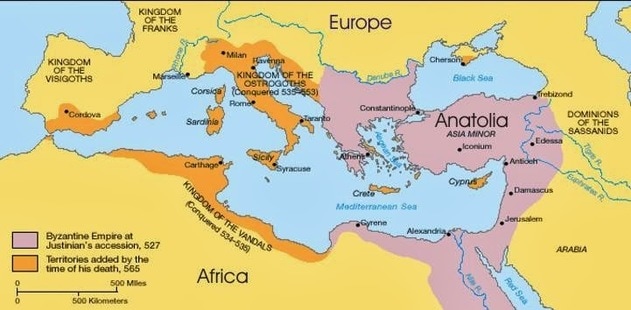
But his greatest achievements were still to come. In 534, Justinian entrusted him with the reconquest of North Africa from the Vandals, a campaign completed with astonishing speed, taking just one year. With that success under his belt, the next year he led imperial armies into Italy against the Ostrogoths. This was to prove a much more challenging proposition for the young general, taking nearly nineteen years before he eventually returned Italy and the Adriatic littoral to the empire and restored Rome itself to imperial rule.
Summoned by his emperor to fight another war in the east against the Persians, Belisarius returned to Italy in 544, where the situation had deteriorated in his absence. This campaign was less successful, and in 548 Justinian relieved him of his command. He retired from military affairs, though he was briefly recalled to repel a Hunnish invasion.
In 562, he was accused of participating in a conspiracy against the emperor, brought to trial and found guilty. Justinian, however, pardoned him and restored him to favour at the imperial court. He died in 565, within a few months of the emperor.
Belisarius was, according to the military historian Basil Liddell-Hart, “a master of the art of converting his weakness into strength; and the opponent’s strength into a weakness”. Time and time again, he achieved remarkable victories against apparently impossible odds. Frequently starved of resources by a stingy emperor and forced to navigate the jealous suspicions of the imperial court, he nevertheless remained bone loyal to Justinian. The emperor, for his part, admired him but also feared the popularity and prestige that successful generals could acquire.
This tension between emperor and servant eventually gave rise to the legend immortalised in David’s painting. According to the story, which dates to centuries after his death, Justinian falsely accused Belisarius of conspiracy, had him blinded, and cast him into poverty. One version even claimed that the fallen general begged in the streets, crying: “Give an obol to Belisarius!” But there is no reliable evidence that any of this occurred, and the tragic tale of the blind beggar was a literary invention — albeit one that proved irresistible to later generations.
The Painting
At first glance, Belisarius Begging for Alms appears entirely classical in subject and style. David’s composition reflects the emerging Neoclassical movement: restrained emotion, carefully balanced figures, and a moral seriousness inspired by antiquity.
Yet beneath the historical scene lay a deeply contemporary message.
When David painted the work in 1781, France was still under the rule of Louis XVI. Open criticism of monarchy was dangerous, but criticism disguised as ancient history was safer. The story of Belisarius allowed artists and writers to explore a provocative question: what happens when rulers become arbitrary, ungrateful, or unjust?
The emotional centre of the painting is not simply Belisarius himself, but recognition. The old man, blind and humiliated, is suddenly recognised by a former soldier who cannot believe the empire has abandoned its greatest defender. David invites the viewer to share the soldier’s shock and moral outrage.
In this sense, the painting is less about Byzantium than about eighteenth-century France. Belisarius becomes the embodiment of virtue betrayed by power. Justinian — though absent from the canvas — represents the dangers of unchecked authority, where favour can turn instantly into ruin.
The subject had already become popular among Enlightenment thinkers. Writers used Belisarius as a symbol of tolerance, justice, and the moral obligations of rulers toward those who served them faithfully. David’s painting brought those ideas vividly to life.
Seen from the perspective of history, the timing is remarkable. Only eight years later, the French Revolution would erupt, sweeping away the monarchy and transforming David himself into one of the Revolution’s leading artists.
In hindsight, Belisarius Begging for Alms feels almost prophetic: a warning, painted in the language of antiquity, about a political system losing its moral legitimacy.

