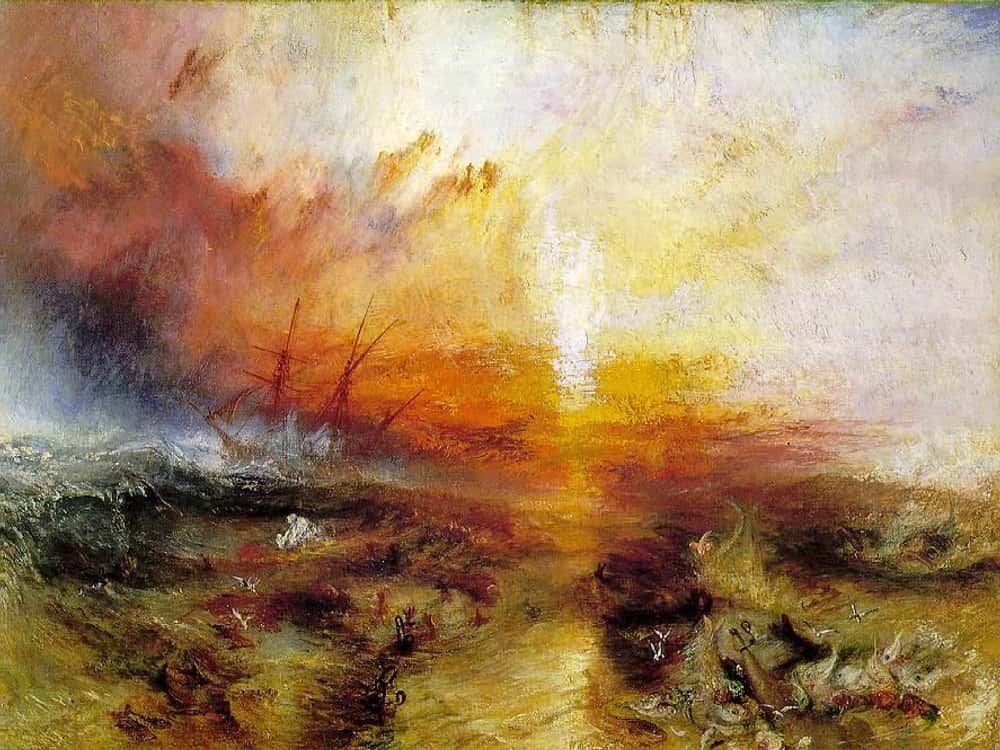
There are few paintings in the history of British art quite as disturbing as J. M. W. Turner’s The Slave Ship. At first glance, it might appear to be another of Turner’s magnificent seascapes, with a sailing ship struggling against the elements beneath a spectacular, blood-red sky.
But look more closely at the foreground and a terrible picture emerges. Among the waves are the limbs of drowning men and women, some still bearing the iron shackles in which they have been thrown into the sea.
The painting’s original title, Slavers Throwing Overboard the Dead and Dying – Typhoon Coming On, leaves little doubt as to what is happening. What makes the picture particularly horrifying, however, is that it was almost certainly inspired, at least in part, by a real incident that had taken place nearly sixty years earlier. It was an episode that exposed the extraordinary moral bankruptcy of the slave trade and helped galvanise the movement to abolish it.
Massacre aboard the Zong
In the latter part of the eighteenth century, Britain was the world’s leading participant in the transatlantic slave trade. Ships sailed from Liverpool, Bristol and London carrying manufactured goods to the west coast of Africa, where these goods were exchanged for enslaved people. The captives were then transported across the Atlantic and sold to plantation owners in the Americas. The ships returned to Britain carrying commodities such as sugar, tobacco and cotton. It was an enormously profitable business, and considerable British fortunes were founded upon it.
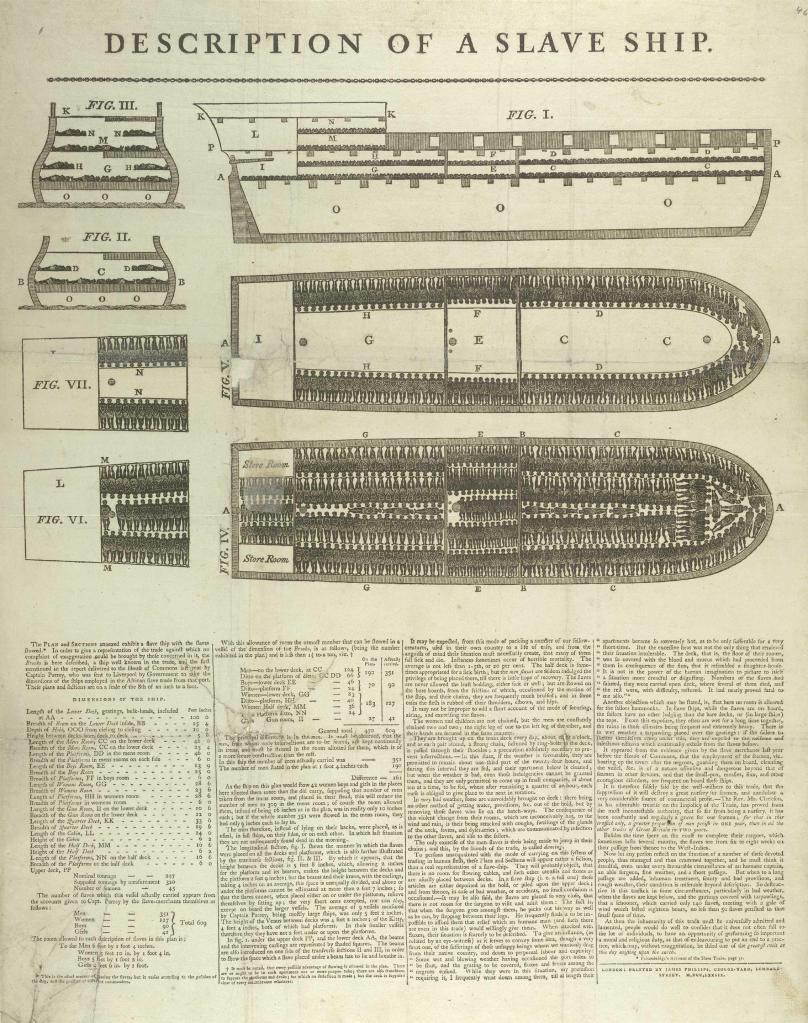
The most notorious part of this so-called Triangular Trade was the Middle Passage, the voyage from Africa to the Americas. The conditions aboard the slave ships were almost unimaginably appalling. Hundreds of people were crammed into confined spaces below decks, with little ventilation, inadequate sanitation and barely sufficient food and water. Disease was endemic and deaths were regarded by the merchants who financed the voyages as an inevitable cost of doing business.
In August 1781, a British-owned slave ship named the Zong departed from the coast of what is now Ghana, bound for Jamaica. Owned by a syndicate of Liverpool merchants, the ship was carrying more than 440 enslaved Africans, approximately twice the number it was designed to accommodate. Its captain, Luke Collingwood, had previously served as a surgeon aboard slave ships.
It was a disastrous voyage. Disease spread through the overcrowded vessel, claiming the lives of captives and crew members alike, while navigational errors prolonged the journey, putting additional pressure on the ship’s supplies.
What followed was the product of a particularly grotesque feature of eighteenth-century maritime insurance. The ship’s owners had insured their human cargo, but the insurers were not normally liable for losses resulting from illness or natural death. If, on the other hand, cargo had to be thrown overboard in an emergency to preserve the safety of the vessel, its loss could be covered by the insurance policy.
More than 130 enslaved Africans were deliberately sent to their deaths. The subsequent justification was that the supply of drinking water was insufficient to sustain everyone aboard until the ship reached Jamaica. There was, however, considerable reason to doubt this explanation, not least because rain had replenished the ship’s water supplies before the killing had ceased.
The massacre was an act of commercial calculation, made possible by a legal and economic system in which human beings were classified as merchandise.
The trial that was not a murder trial
Perhaps the most extraordinary aspect of the Zong affair was what happened afterwards.
When the ship’s owners submitted their insurance claim, the underwriters refused to pay. The resulting dispute came before an English court in 1783 in a case known as Gregson v Gilbert.
It is worth emphasising that nobody was on trial for murder. The question before the court was whether the insurance company was obliged to compensate the merchants for the loss of their property.
The original jury found in favour of the ship’s owners. The insurers subsequently challenged the verdict before the Court of King’s Bench, presided over by Lord Mansfield. Evidence concerning the availability of drinking water cast doubt on the supposed necessity of the killings, and a new trial was ordered. There is no surviving record of that trial having taken place.
The affair had, however, come to the attention of two important figures in the emerging British abolitionist movement.
The first was Olaudah Equiano, a formerly enslaved man who had purchased his freedom and become a prominent campaigner against the slave trade. He brought the case to the attention of Granville Sharp, one of Britain’s earliest and most determined opponents of slavery.
Sharp attempted to have those responsible prosecuted for murder, appealing to the country’s legal and political authorities. His efforts came to nothing. Nobody was ever held criminally responsible for the massacre.
But the affair gave the abolitionists a particularly compelling example of the consequences of reducing human life to a monetary value. It helped make the slave trade a subject of increasingly uncomfortable public debate.
The abolitionist movement
Opposition to slavery was nothing new. Enslaved people themselves had resisted their enslavement for as long as the institution had existed. What changed in the latter part of the eighteenth century was the emergence of a broad, organised political movement in Britain dedicated to bringing the trade to an end.
Among its earliest supporters were the Quakers, whose religious convictions led them to reject the ownership of one human being by another. They were joined by evangelical Christians, humanitarian reformers and others influenced by Enlightenment ideas about natural rights and human liberty.
In 1787, the Society for Effecting the Abolition of the Slave Trade was established in London. Its leading figures included Granville Sharp and Thomas Clarkson, the latter of whom devoted much of his life to collecting evidence of the abuses associated with the trade. Its most famous parliamentary champion was William Wilberforce, a young Yorkshire MP and evangelical Christian.
But it would be misleading to present abolition as exclusively the achievement of a handful of enlightened white Englishmen. Black campaigners played an indispensable role. Equiano’s autobiography, published in 1789, provided British readers with a personal account of the experience of enslavement. Other Black writers and speakers, including Ottobah Cugoano, challenged both the institution of slavery and the moral complacency of British society.
The abolitionists were remarkably innovative in their methods. They organised petitions, public meetings and consumer boycotts, published pamphlets and distributed illustrations depicting conditions aboard slave ships.
Women, despite being largely excluded from formal political life, played an important role in the campaign, particularly in organising boycotts of sugar produced by enslaved labour in the West Indies.
The movement faced formidable opposition. Merchants, plantation owners and their parliamentary allies argued that abolition would ruin British commerce, devastate the economies of the colonies and hand a commercial advantage to Britain’s rivals.
Events outside Britain also helped transform the debate. The great uprising in the French colony of Saint-Domingue in 1791, which ultimately resulted in the establishment of independent Haiti in 1804, demonstrated the capacity of enslaved people to overthrow the system themselves. Later uprisings in Britain’s own Caribbean colonies, notably the Jamaican rebellion of 1831–32, added further urgency to the question of emancipation.
In 1807, after two decades of sustained campaigning, Parliament finally passed legislation abolishing British participation in the slave trade.
It was an important victory, but it did not abolish slavery itself. Hundreds of thousands of people remained enslaved in Britain’s overseas possessions.
That required a further generation of campaigning. The Slavery Abolition Act of 1833 provided for emancipation across most of the British Empire, although many of those supposedly freed were compelled to continue working for their former owners under a system euphemistically described as ‘apprenticeship’. This system was finally abandoned in 1838.
The British government paid £20 million in compensation to slave owners for the loss of their property. The formerly enslaved received no compensation for the loss of their liberty.
Turner and slavery
Given the nature of The Slave Ship, it might be tempting to assume that Joseph Mallord William Turner had been a lifelong opponent of slavery. The truth, however, appears to have been rather more complicated.
In 1805, when Turner was thirty years old and already an established painter, he invested £100 in a tontine (a scheme in which the financial benefits accruing to surviving investors increased as other participants died) associated with a Jamaican agricultural estate that depended upon enslaved labour. Turner had therefore voluntarily invested his own money in an enterprise whose commercial viability rested upon slavery.
Turner also had professional connections with people whose wealth derived, directly or indirectly, from slavery. In this respect, he was hardly unusual. The proceeds of the Caribbean plantation economy permeated British society, and the world of art collecting and patronage was no exception.
But it seems that his attitudes to slavery changed over the course of his lifetime, and by the later stages of his career Turner appears to have become increasingly sympathetic to the abolitionist cause. He moved in circles that included opponents of slavery, and his choice of subject matter in 1840 provides compelling evidence of how far his attitudes had changed.
One likely source of inspiration for The Slave Ship was Thomas Clarkson’s history of the campaign to abolish the slave trade. Originally published in 1808, it was reissued in 1839 and contained an account of the Zong massacre.
There was another important reason for Turner to address the subject at this particular time.
In June 1840, London hosted the first World Anti-Slavery Convention, which attracted delegates from a number of countries, particularly Britain and the United States. By then, slavery had largely been abolished in Britain’s own colonies, but it continued to flourish elsewhere, and the illegal transatlantic traffic in enslaved Africans remained a lucrative enterprise.
The international abolitionist movement was now concerned with bringing about the extinction of slavery throughout the world.
Turner exhibited his painting at the Royal Academy in the same season as the convention. Whether he deliberately timed its appearance to coincide with the gathering cannot be established with certainty, but the choice of subject was particularly topical.
Turner was not simply reminding his audience of an atrocity committed sixty years earlier. He was drawing attention to the continuing existence of the system that had made it possible.
The painting
The Slave Ship is not, strictly speaking, a historical reconstruction of the events aboard the Zong. Turner combined the historical incident with other influences, including an eighteenth-century poetic description of a slave ship overtaken by a tropical storm.
There is no evidence that the Zong encountered anything resembling the typhoon depicted in the painting at the time of the massacre. The storm is Turner’s invention, or at least his adaptation of other material, and is essential to the moral and emotional impact of the work.
By 1840, Turner was sixty-five years old and had entered the extraordinary final phase of his artistic career. His paintings had become increasingly concerned with the effects of light, colour and atmosphere, often at the expense of the clearly defined forms that characterised more conventional painting.
All those qualities are evident in The Slave Ship.
The vessel itself occupies a surprisingly small portion of the canvas. Its dark silhouette is almost engulfed by the violent sea and the overwhelming brilliance of the sky. The victims occupy the foreground, scattered among the waves and surrounded by marine creatures.
The predominant colours are reds, oranges and yellows, giving the sunset an almost apocalyptic quality. Sea and sky seem to merge into one another, and it is difficult to escape the impression that the whole natural world has been convulsed by what has taken place.
The approaching storm can be read as a form of divine retribution, with the slave ship sailing towards its own destruction. Nature, it seems, is about to pronounce the judgement that human justice had failed to deliver.
When Turner exhibited the painting, he accompanied it with lines from his unfinished poem, Fallacies of Hope:
Before it sweeps your decks, throw overboard
The dead and dying – ne’er heed their chains.
Hope, Hope, fallacious Hope!
Where is thy market now?
That last question is particularly significant. The language of commerce intrudes into the midst of a scene of human suffering, reminding the viewer that the events depicted were the consequence not of some spontaneous act of savagery, but of the pursuit of profit.
The painting divided contemporary critics, some of whom found Turner’s increasingly unconventional style bewildering. Among its greatest admirers, however, was the young art critic John Ruskin, whose father acquired the painting and subsequently presented it to his son. Ruskin regarded it as one of Turner’s supreme achievements.
The Zong massacre exposed a world in which the deliberate killing of human beings could be treated by the courts as a dispute over the terms of an insurance contract. Nearly sixty years later, Turner transformed that cold commercial calculation into an image of overwhelming horror.
In doing so, he produced not only one of the greatest paintings of his career, but one of the most memorable indictments of slavery in Western art.

